Kemi Badenoch’s Conservative Gambit: How Britain’s Opposition Is Betting on Hard-Right Realignment
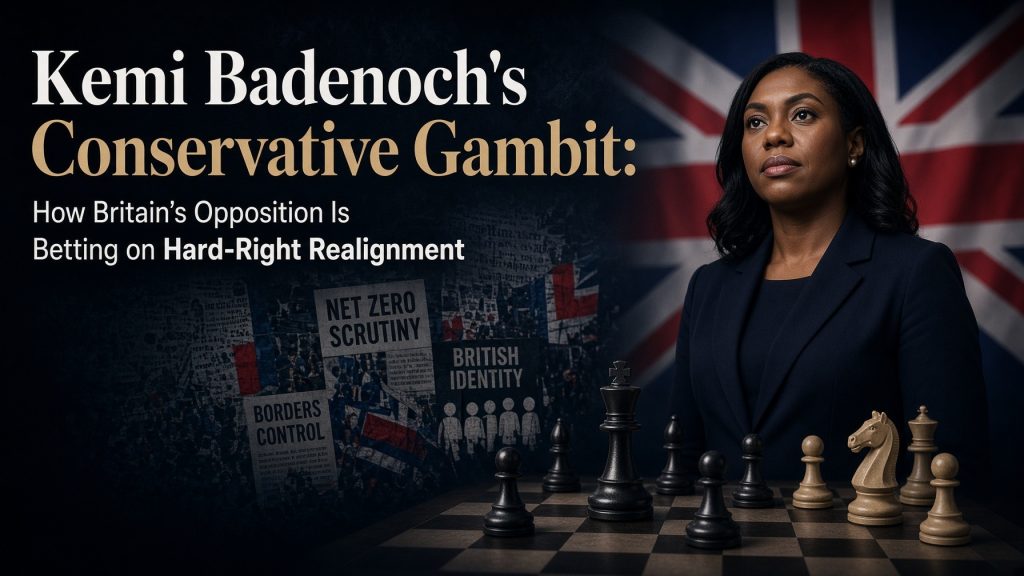
Kemi Badenoch is turning the Conservative Party’s most toxic historical label into a political weapon. As Britain’s official opposition doubles down on hard-right positioning at its October 2026 party conference, the strategic calculus is becoming impossible to ignore: the Tories are not trying to win back the centre — they are betting everything on ideological consolidation and a realignment of the British right that could reshape the country’s political economy for a decade.
What Happened — And Why It Matters
At the Conservative Party’s autumn conference in October 2026, leader Kemi Badenoch delivered a signal that cut through the usual political noise: being called the “Nasty Party” is no longer a warning to be heeded — it is a standard to be raised. The label, first weaponised against the Conservatives in the early 2000s, has historically served as shorthand for policies perceived as cruel, exclusionary, or economically punishing to the vulnerable. Badenoch is inverting that entirely.
This is not merely rhetorical theatre. It reflects a considered strategic bet that the British political landscape has shifted far enough rightward — accelerated by Brexit, immigration anxiety, and Labour’s governance struggles — that a party openly hostile to progressive consensus can harvest sufficient votes to compete for power. The economic subtext is equally stark: Badenoch’s platform implies deep spending cuts, a renegotiation of the UK’s post-Brexit trade posture, and a confrontational stance toward international institutions that markets have already begun pricing as tail risk.
The Conservative Party suffered its worst electoral result in modern history at the July 2024 general election, losing 121 seats and returning just 121 MPs. Badenoch inherited a rump parliamentary party and a fractured coalition. Her conference positioning suggests she has concluded that rebuilding from the centre is both electorally impossible and philosophically undesirable.
Economic Context
Britain’s macroeconomic backdrop is not offering Badenoch easy terrain. The UK carries a public debt load approaching £2.3 trillion — over 98% of GDP — with the Bank of England holding its benchmark rate at 4.75% as it continues to navigate the tension between residual inflation and anaemic growth. GDP expansion came in at 1.1% across 2025, among the weakest in the G7, and real wage growth remains fragile despite nominal gains.
Against this backdrop, Badenoch’s brand of economic conservatism — tax cuts, deregulation, reduced state footprint — carries both electoral appeal and significant fiscal risk. Any credible policy platform she advances toward the next general election, which must occur by mid-2029, will need to square the circle of promised tax relief with a debt-to-GDP ratio that gives bond markets little room for manoeuvre. The gilt market has already demonstrated in recent years that it will not hesitate to discipline governments that stray from fiscal orthodoxy.
Immigration, which intersects directly with labour market economics, is central to Badenoch’s positioning. Net migration to the UK remained elevated through 2025 despite Labour government measures, and polling consistently shows the issue ranking in the top three economic concerns for British voters — tied to housing costs, wage compression in specific sectors, and public services capacity. Badenoch has made clear she will push policy significantly beyond current government settings.
A Conservative government pursuing simultaneous tax cuts and immigration restriction would face compounding pressure: reduced labour supply constrains growth, while lower revenues tighten the fiscal envelope. Bond markets would scrutinise any such platform with extreme prejudice given the UK’s existing debt trajectory.
Key Stakeholders
Driving the realignment agenda, betting that ideological clarity outperforms centrist triangulation. Her support base within the parliamentary party is solid but her public approval ratings remain below 30%.
The existential competitive threat. Reform pulled over 14% of the national vote in the 2024 general election, drawing directly from the Conservative base. Badenoch’s hard-right turn is explicitly designed to collapse this flank.
Already sensitised to political risk after previous fiscal shocks. Any credible Badenoch policy platform combining tax cuts with spending reduction will be stress-tested ruthlessly against the UK’s £2.3 trillion debt load.
Governing with a commanding parliamentary majority but facing approval ratings that have declined sharply since taking office. Economic underperformance is Badenoch’s primary opening — if it materialises at scale by 2028.
Timeline: The Conservative Collapse and Rebuild
- July 2024Conservatives suffer catastrophic general election defeat, losing 121 seats and returning just 121 MPs. Labour wins a landslide majority. Rishi Sunak resigns as party leader immediately.
- Late 2024Kemi Badenoch wins the Conservative leadership contest, defeating Robert Jenrick in the final membership ballot. She becomes the first Black woman to lead a major British political party.
- Early 2025Badenoch begins repositioning the party on culture, immigration, and state spending — drawing criticism from centrist Tories but consolidating support among the activist base.
- Mid 2025UK GDP growth remains stuck at 1.1% annually. Labour’s poll lead begins narrowing as cost-of-living pressures persist. Conservative polling stabilises around 18%.
- October 2026Conservative Party conference: Badenoch openly embraces the “Nasty Party” framing as a badge of ideological honesty, signalling the hard-right strategy is now locked in for the cycle.
The Investor Angle
For investors with UK exposure — sterling assets, gilts, FTSE-listed domestics — Badenoch’s rise matters beyond electoral curiosity. Her policy platform, if it hardens further toward the next election cycle, introduces a binary risk scenario: either it disciplines Labour into tighter fiscal policy, which is mildly constructive for gilts, or it wins power and attempts rapid deregulation and tax reduction, which could spark another bout of gilt volatility reminiscent of the September 2022 episode when 10-year yields spiked over 100 basis points in days.
Sterling would likely come under pressure in any scenario where a Badenoch-led government signals confrontation with Brussels over trade arrangements or signals unfunded fiscal loosening. The pound has already absorbed Brexit-era discounts versus purchasing power parity benchmarks, and further political risk premiums would compound that drag. Investors should monitor Conservative policy development through 2027 with the same attention given to Federal Reserve forward guidance — the optionality here is not trivial.
A Conservative government under Badenoch that pursues a more adversarial posture toward the EU could destabilise the post-Brexit trade and cooperation framework that Labour has carefully rebuilt since 2024. Any regression in UK-EU relations would directly impact roughly £660 billion in annual bilateral trade flows — the UK’s largest trading relationship — and could trigger fresh uncertainty around financial services equivalence arrangements that the City of London depends on for cross-border market access.
Geopolitical Dimensions
Britain’s political realignment does not occur in a vacuum. The broader Western political economy is contending with a resurgence of nationalist conservatism across multiple major democracies, and Badenoch’s positioning consciously draws from that international current. Her ideological alignment with harder-right movements in Europe and North America creates both diplomatic complexity and potential economic consequence — particularly around defence spending commitments, trade policy, and multilateral institution engagement.
NATO spending is one area where hard-right governments have been under pressure to demonstrate credibility. The UK currently spends approximately 2.3% of GDP on defence, above the NATO benchmark, but Badenoch has signalled she would push further — a commitment with real fiscal weight given the existing debt trajectory. The interplay between defence spending ambition, tax cut rhetoric, and public debt arithmetic is where Badenoch’s platform faces its most severe internal tension.
A High-Stakes Ideological Bet With Measurable Market Consequences
Badenoch’s embrace of the “Nasty Party” identity is not political recklessness — it is a calculated wager that the British electorate’s centre of gravity has moved, and that Labour’s economic underperformance will create the opening needed for a hard-right opposition to compete by 2028-2029. The logic is coherent. The execution risk is enormous.
For markets, the critical watch points are: Conservative poll trajectory through 2027, any formal policy costing that touches gilt dynamics, and whether Badenoch moves to formally absorb Reform UK’s voter base or allows it to persist as a competitive threat. A fragmented right-wing vote is Labour’s insurance policy. A consolidated one — under a leader willing to own the nastiness — is a different calculation entirely. Position accordingly.
This article is for informational purposes only and does not constitute financial advice. Always conduct your own research before making investment decisions.