Russian Strike Targets High-Value Train Carrying Western Officials Near Polish Border as Ukraine War Enters Dangerous New Phase
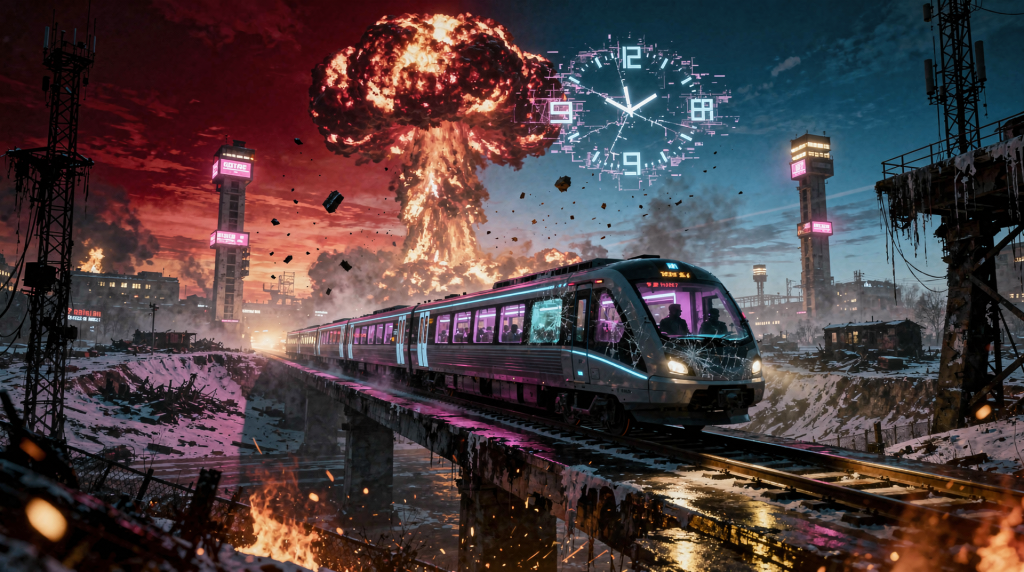
A Russian strike near the Polish border has targeted a Kyiv-to-Warsaw passenger train believed to be carrying former UK Prime Minister Boris Johnson and a former CIA director, according to officials — a brazen escalation that marks the most direct threat to Western political figures since the full-scale invasion began in February 2022 and sends shockwaves through the geopolitical calculus underpinning European security architecture.
What Happened — and Why It Matters
On September 13, 2026, a Russian drone struck in the vicinity of the Kyiv-to-Warsaw passenger rail line near the Polish border. Officials confirmed that a train carrying Boris Johnson — the former British Prime Minister who became one of Ukraine’s most prominent Western advocates — and a former director of the United States Central Intelligence Agency was believed to have been the intended target of the strike.
The incident represents a seismic shift in the rules of engagement that have, until now, largely governed the conflict’s boundaries. While Russia has systematically targeted Ukrainian infrastructure, military positions, and civilian population centers throughout the war, a deliberate strike against a moving train known to carry sitting or former Western heads of government and senior intelligence officials is qualitatively different. It signals that the Kremlin is prepared to directly threaten Western political figures on Ukrainian soil — or in the immediate approaches to NATO territory.
The strike near the Polish border is particularly alarming. Poland is a NATO member state. Any ordinance that strays, or is intentionally directed, across that frontier triggers immediate Article 5 deliberations among the alliance’s 32 members. The proximity of the strike to sovereign NATO territory is not incidental — it is a deliberate calibration of pressure, testing the West’s red lines with maximum deniability.
The Kyiv-to-Warsaw rail corridor has served as the primary humanitarian and logistics artery connecting Ukraine to the European Union since 2022. Targeting this route — particularly a passenger service — combines military intimidation with economic disruption and political provocation in a single strike.
Economic Context — The Cost of the Corridor
The rail link between Kyiv and Warsaw is more than a passenger service. It is the physical spine of Western material support to Ukraine. Since the full-scale invasion began in February 2022, billions of dollars in military aid, humanitarian supplies, and reconstruction materials have transited this corridor. The European Union alone has committed over €110 billion in financial, military, and humanitarian support to Ukraine across the conflict’s duration — a significant portion of which has flowed through this exact logistical channel.
Ukraine’s GDP contracted by approximately 30% in 2022 before beginning a gradual recovery, with growth estimated at around 3–5% annually in subsequent years, heavily contingent on continued Western financial transfers and the integrity of cross-border supply chains. Any sustained interdiction of the Polish corridor would directly threaten the economic scaffolding keeping Ukraine’s wartime economy functional.
For Poland, which has absorbed over 1.5 million Ukrainian refugees and seen its defense spending surge to 4% of GDP — the highest in NATO — the strike near its border raises immediate questions about the economic cost of proximity to an escalating conflict. Warsaw has already committed tens of billions of zloty to border fortification and military expansion; a direct incident on Polish territory would trigger expenditure of an entirely different magnitude.
The EU has pledged over €110 billion in total support to Ukraine since 2022. Disruption to the Kyiv-Warsaw rail corridor — through sustained targeting — would force a fundamental restructuring of that aid delivery pipeline, raising costs and transit times significantly across the entire Western support architecture.
Key Stakeholders
Former UK Prime Minister and one of Ukraine’s most vocal Western champions since 2022. His presence on the train underscores the continued personal diplomacy conducted by former Western leaders outside official government channels.
A senior American intelligence figure traveling in the same diplomatic corridor. The presence of a former US intelligence chief alongside a former UK PM suggests the trip carried significant strategic purpose beyond a routine visit.
The strike’s proximity to the Polish border immediately invokes Article 5 threshold discussions. NATO’s 32 members must now assess whether this constitutes an intentional provocation against the alliance’s territorial integrity.
The targeting intelligence required to identify a specific passenger train’s manifest suggests sophisticated surveillance capability — either through signal interception, human intelligence, or satellite tracking of VIP movements.
Timeline of Escalation
- Feb 2022Russia launches full-scale invasion of Ukraine. The Kyiv-Warsaw rail corridor immediately becomes the primary Western aid and evacuation lifeline.
- 2022–2024Russia systematically targets Ukrainian energy infrastructure, civilian areas, and military logistics. Western leaders, including Boris Johnson, make high-profile visits to Kyiv via the rail route.
- 2025Conflict enters attritional phase. Russia expands drone warfare capabilities, extending strike range and precision against infrastructure targets deeper into Ukrainian territory.
- Sept 13, 2026Russian drone strike targets the Kyiv-Warsaw passenger line near the Polish border. Officials confirm the train was believed to be carrying Boris Johnson and a former CIA director. Strike occurs within proximity of NATO sovereign territory.
The Investor Angle
Markets have long priced Ukraine-Russia conflict risk as a contained regional variable — devastating for Ukrainian assets and regional neighbors, but broadly ring-fenced from European and global financial stability by a series of assumed red lines. This strike challenges each of those assumptions simultaneously.
Defense stocks across European exchanges have been among the strongest performers over the conflict’s duration, with major aerospace and defense contractors recording multi-year highs as NATO members raced to replenish inventories and expand military capacity. Poland’s defense procurement surge alone — with spending at 4% of GDP — has generated substantial contract flows for European and American defense industrial bases.
The immediate market risk from this incident lies not in its direct economic damage but in its signaling function. If Russia is willing to target a train carrying a former G7 prime minister and a former intelligence chief of the world’s most powerful nation, the probability of further escalation — potentially drawing NATO into direct engagement — has materially increased. That scenario, even as a tail risk, reprices European sovereign bonds, energy futures, and safe-haven assets in ways that extend far beyond the conflict zone.
Energy markets remain the most direct transmission mechanism. European natural gas prices, which spiked dramatically in 2022 following the disruption of Russian pipeline flows, remain sensitive to geopolitical shock. Any military incident that raises the probability of NATO-Russia confrontation will immediately translate into energy price volatility, with cascading effects across European industrial competitiveness and inflation trajectories.
The strike’s proximity to Polish territory — a NATO member — creates a genuine Article 5 escalation risk that markets have not fully priced. If subsequent investigation determines the strike was intentionally directed toward NATO-adjacent space, the political pressure on the alliance to respond kinetically could overwhelm diplomatic containment mechanisms. European energy futures, defense procurement budgets, and sovereign credit spreads across Eastern Europe would all face immediate repricing pressure in such a scenario.
What Comes Next
Western governments will face immediate pressure to respond to what officials are characterizing as a deliberate targeting of their nationals — including a figure of prime ministerial rank. The diplomatic response calculus is extraordinarily complex: an aggressive reaction risks further escalation with a nuclear-armed state, while a muted response signals that Western VIPs can be struck with impunity on Ukrainian soil.
For Ukraine, the incident creates both a crisis and an opportunity. The brazenness of the apparent targeting may generate renewed political will in Western capitals — particularly in Washington and London — to dramatically increase the scale and sophistication of military support. Conversely, it may cause some Western officials to reconsider high-profile visits that could be leveraged as provocations or targeting opportunities by Russian forces.
The intelligence dimension is equally consequential. That Russian forces appear to have had actionable information about the specific train’s passenger manifest points to a surveillance and intelligence penetration capability that Western security services will now scramble to assess and counter.
A Calculated Provocation That Redraws the Conflict’s Boundaries
This is not a random infrastructure strike. The apparent targeting of a passenger train carrying a former G7 prime minister and a former CIA director near NATO’s eastern border is a deliberate geopolitical signal — one calibrated to test Western resolve, demonstrate Russian intelligence reach, and probe alliance cohesion at a moment of sustained attritional pressure. The economic scaffolding of Western support to Ukraine runs directly through the corridor that was struck.
Watch the NATO emergency consultations in the days ahead, the formal assessment of strike proximity to Polish territory, and whether Western governments move to dramatically upgrade their military support packages in response. The tail risk of direct NATO-Russia engagement — while still unlikely — has moved materially closer to the probability distribution’s center. Position accordingly across energy, European defense, and safe-haven assets.
This article is for informational purposes only and does not constitute financial advice. Always conduct your own research before making investment decisions.