AI’s Biggest Power Moves: Anthropic Goes Public, SpaceX Bets $40B on GPUs, and Autonomous Excavators Hit $4.1B Valuation
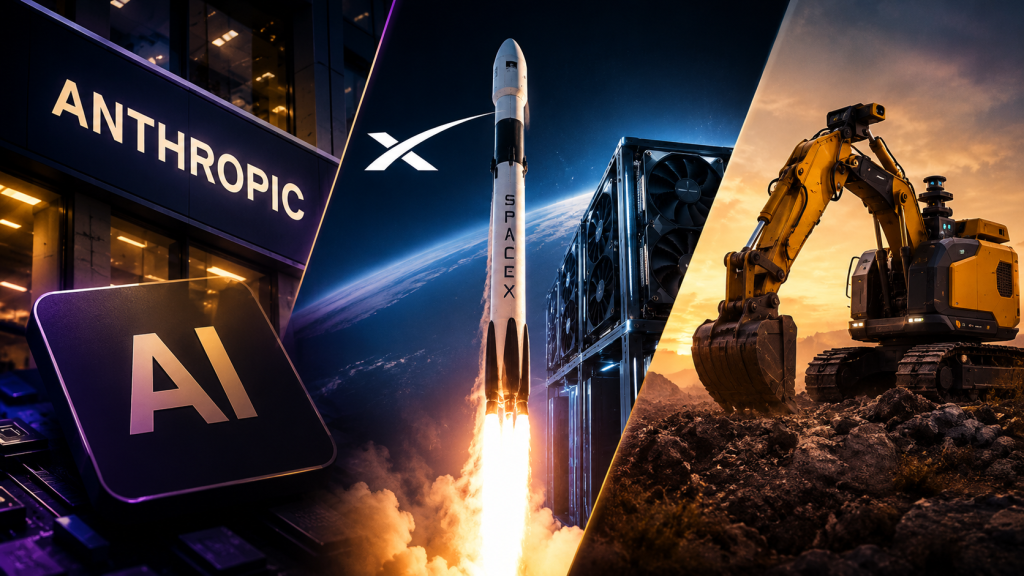
In a single trading day, the AI infrastructure arms race produced three seismic moves that collectively redraw the map of where capital is flowing and who controls the compute stack: Anthropic submitted its IPO filing to go public, SpaceX locked in a record $40 billion GPU financing facility with Apollo Global Management, and autonomous construction robotics firm Bedrock Robotics closed a $600 million funding round at a $4.1 billion valuation. October 26, 2026 will be remembered as the day AI’s industrial phase became undeniable.
Anthropic Opens the Books
Anthropic’s decision to file for its public market debut marks the most consequential AI IPO since the sector’s modern era began. The company, built on an explicit AI safety mandate and the Claude family of large language models, is now submitting to the scrutiny of public markets — a move that reveals soaring revenue figures alongside mounting losses that characterize every frontier AI operator at this stage of the compute cycle.
What distinguishes Anthropic’s filing from a standard tech IPO is its governance architecture. The company has structured its public offering around mechanisms designed to preserve founder control and protect its stated safety mission from shareholder pressure — an unusual concession that public market investors will have to accept or reject on its face. Dario Amodei and the founding team retain structural authority even as the company opens its cap table to institutional and retail buyers.
Enterprise adoption has been the primary revenue engine. Anthropic’s Claude models have secured significant enterprise deployment contracts across industries, driven by Claude’s strong performance on coding, reasoning, and long-context tasks. The IPO filing lays bare the full picture of that momentum — and the cost of sustaining it.
Anthropic’s public filing discloses soaring revenue growth combined with significant operating losses — a pattern consistent with every major frontier AI lab burning capital to maintain model competitiveness. The governance structure, designed to lock in founder control and the safety mission, is without modern precedent in a major tech IPO.
SpaceX Makes the Largest GPU Financing Commitment in History
SpaceX disclosed in a regulatory filing that it has secured a binding commitment for approximately $40 billion in financing from Apollo Global Management, designated specifically for AI chips and data center infrastructure. The company itself characterized the arrangement as the “largest committed GPU financing” deal ever executed — and by any available comparison, that claim holds.
The scale of the commitment signals that SpaceX’s AI ambitions — centered on its xAI-adjacent compute buildout and Starlink’s AI integration layer — require infrastructure investment that dwarfs what traditional venture or corporate balance sheets can absorb alone. Routing $40 billion through a structured financing vehicle with Apollo allows SpaceX to accelerate GPU acquisition without diluting equity at a moment when its private valuation sits near the top of any company globally.
The deal also validates a broader trend: alternative asset managers are becoming the primary financing rails for AI hardware accumulation. Banks move too slowly and carry regulatory constraints. Private credit firms like Apollo can structure bespoke facilities at the speed the GPU procurement cycle demands.
At $40 billion, SpaceX’s GPU financing facility with Apollo represents the single largest committed infrastructure financing deal for AI compute ever disclosed. It sets a new benchmark for how frontier AI operators will fund hardware accumulation through private credit rather than equity or traditional bank lending.
Bedrock Robotics: AI Leaves the Data Center, Enters the Construction Site
While Anthropic and SpaceX dominate the software and infrastructure layers, Bedrock Robotics’ $600 million raise at a $4.1 billion valuation represents something different: AI moving into physical labor markets at scale. Bedrock has built autonomous excavator systems targeting the construction industry, where a deepening shortage of skilled heavy equipment operators is creating structural demand for robotic alternatives that no wage increase can fully address.
The excavator is not an arbitrary entry point. It is one of the most technically demanding pieces of construction equipment to operate, requires years of skilled training, and is central to virtually every major infrastructure project — from data center groundbreaking to highway construction to utility trenching. Automating it unlocks a compounding productivity gain across the entire project pipeline.
A $4.1 billion valuation on a $600 million raise positions Bedrock as one of the most heavily capitalized construction robotics companies in existence, reflecting investor conviction that the labor shortage problem is structural and that AI-guided autonomy is the only scalable solution.
Key Players Reshaping the AI Stack
Filed for public debut with soaring revenue, mounting losses, and an unprecedented governance structure preserving founder control and AI safety mission post-IPO.
Secured $40B in binding GPU financing from Apollo — the largest committed AI compute financing facility ever disclosed — to build out data center and AI chip infrastructure.
Emerges as the premier private credit backer of AI infrastructure, structuring the $40B SpaceX facility and cementing alternative asset managers as the new AI hardware banks.
Raised $600M at a $4.1B valuation to deploy autonomous excavators at scale, targeting a structural operator shortage that is accelerating demand for construction AI.
Investment Implications
The convergence of these three developments on a single day is not coincidence — it reflects a maturation phase in AI investment where the frontier has expanded from model training to physical infrastructure buildout to autonomous machinery. Capital is no longer concentrating exclusively in model labs. It is flowing to whoever controls the compute stack, the power grid connections, and the physical labor displacement layer.
Anthropic’s IPO creates a public equity vehicle for investors who want direct exposure to frontier model development with a safety-first governance wrapper. SpaceX’s $40 billion GPU deal positions private credit as a critical asset class for AI infrastructure exposure. And Bedrock Robotics at $4.1 billion signals that construction tech — historically a slow-moving sector — is now attracting AI-tier valuations when the automation thesis is credible and the labor market tailwind is structural.
For investors, the meta-signal is clear: the AI infrastructure buildout is not slowing, and the capital required to sustain it is scaling faster than any single financing mechanism can support. Equity, private credit, and venture are all being deployed simultaneously across every layer of the stack.
Timeline of October 26, 2026
- 14:35 UTCAnthropic officially files for its public debut, disclosing revenue figures, operating losses, enterprise adoption data, and an unusual dual-class governance structure protecting founder control.
- 16:46 UTCSpaceX discloses in a regulatory filing a binding $40 billion GPU financing commitment with Apollo Global Management — the largest such facility ever announced — earmarked for AI chips and data center equipment.
- 17:45 UTCBedrock Robotics announces a $600 million funding round, reaching a $4.1 billion valuation, with autonomous excavator technology targeting the structural shortage of skilled construction equipment operators.
All three developments carry material execution risk. Anthropic’s IPO exposes a company burning significant capital to public market quarterly pressure while attempting to preserve a safety mission that may conflict with margin expansion demands. SpaceX’s $40 billion debt-financed GPU buildout creates a massive liability on the balance sheet if AI revenue projections disappoint. And Bedrock Robotics must demonstrate that autonomous excavation can operate reliably across uncontrolled job site environments — a technical bar that has defeated multiple robotics companies before it.
The AI Industrial Phase Has No Brake Pedal
Three deals. One day. A combined capital commitment exceeding $40 billion across public equity, private credit, and venture funding. The AI sector is no longer in a phase where individual funding rounds are notable — it is in a phase where the infrastructure being financed today will determine competitive positioning for the next decade. Anthropic going public means public investors can finally price frontier AI risk directly. SpaceX’s GPU financing deal means compute accumulation is now a structured credit product. And Bedrock Robotics means the automation wave has reached the construction site.
Watch Anthropic’s IPO pricing for the market’s definitive verdict on what a frontier AI lab with governance constraints is worth in public hands. Watch Apollo’s position in the AI credit market — if $40 billion with SpaceX is the opening move, the pipeline behind it is almost certainly larger. And watch Bedrock’s deployment metrics: if autonomous excavation proves commercially viable at scale, every heavy equipment category becomes a target.
This article is for informational purposes only and does not constitute financial advice. Always conduct your own research before making investment decisions.