Jensen Huang Resigns: Nvidia’s $1.4 Trillion Single Point of Failure
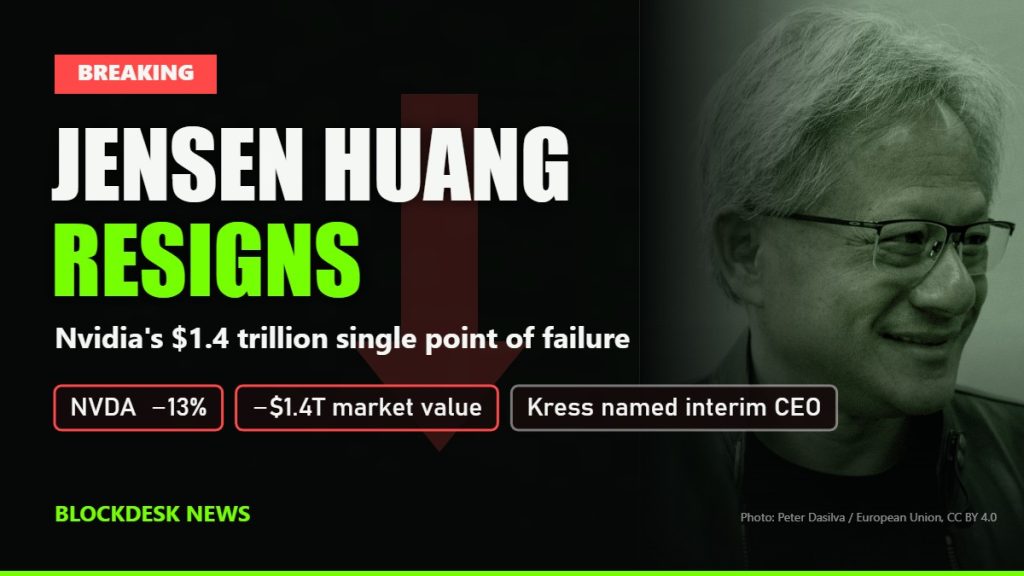
The man who built the engine of the AI boom is gone, effective immediately. Nvidia lost its founder, its top salesman and its face in one press release. Here is how it happened, what it did to markets, and why crypto has been warning about exactly this kind of risk for 17 years.
Quick answer: Jensen Huang resigned as Nvidia’s President, CEO and board member on November 12, 2026, effective immediately, after 33 years. CFO Colette Kress is interim CEO, and Harvey C. Jones becomes Nvidia’s first-ever board chair. Nvidia gave no official reason; the exit follows reports of two extramarital affairs, one with a businesswoman US officials suspect of working for Chinese intelligence. NVDA fell about 13% at the open, and Bitcoin slipped below $72,000.
Key takeaways
- Jensen Huang has resigned as President, CEO and board member of Nvidia, effective immediately, ending a 33-year run at the company he co-founded in 1993.
- CFO Colette Kress is interim CEO and keeps her CFO role. The board will look at internal and external candidates for a permanent replacement.
- Harvey C. Jones, former CEO of Synopsys, becomes Nvidia’s first-ever board chair.
- Nvidia gave no official reason. The exit follows reports of two extramarital affairs, one of them with a businesswoman US officials suspect of working for Chinese intelligence.
- NVDA fell about 10% to 11% premarket, to around $154–156, and roughly 13% at the open. Axios estimates Nvidia has lost about $1.4 trillion in market value in the two weeks since the scandal broke.
- Crypto felt it too: Bitcoin slipped under $72,000 and Ethereum under $2,000 within an hour of the announcement.
| Key fact | Detail |
|---|---|
| Who resigned | Jensen Huang, Nvidia co-founder, President and CEO |
| Date | Thursday, November 12, 2026 (effective immediately) |
| Interim CEO | Colette Kress (also remains CFO) |
| New board chair | Harvey C. Jones (first-ever Nvidia chair) |
| Official reason | None given |
| NVDA stock move | About −10–11% premarket, about −13% at the open |
| Value lost in two weeks | About $1.4 trillion (Axios estimate) |
| Crypto reaction | BTC below $72,000; ETH below $2,000 |
| Next catalyst | Nvidia Q3 FY2027 earnings, November 17, 2026 |
What happened: Jensen Huang resigns as Nvidia CEO
On Thursday, November 12, 2026, Nvidia’s board announced that Jensen Huang had resigned from every role he held at the company: President, Chief Executive Officer and director. The resignation took effect immediately.
Colette Kress, Nvidia’s Executive Vice President and Chief Financial Officer, will run the company on an interim basis while continuing as CFO. The board has started a search for a permanent CEO and says it will consider people from inside and outside Nvidia. It did not give a timeline.
At the same time, the board created a position Nvidia has never had before: a chair of the board. Harvey C. Jones, a technology executive and venture investor who previously ran chip-design software maker Synopsys, takes the seat. Jones said the board has full confidence in Kress and the leadership team, and that operations, customer commitments and the product roadmap should continue without interruption.
The official release thanked Huang for what it called his “immeasurable contributions” to the company and the industry. It did not say why he left.
The irony is hard to miss. At CES in January, Huang was asked how long he planned to stay CEO. His answer: “For as long as I deserve it.” Ten months later, the board and the founder have reached a different conclusion.
Why did Jensen Huang resign? The two-week timeline
This did not come out of nowhere. Here is the timeline.
October 29: the spy report. The New York Times reported that US intelligence officials believe Alice Huang (no relation), an executive at Singapore-based data center operator Megaspeed, was a Chinese intelligence asset who had built a close relationship with Jensen Huang. Megaspeed is a major Nvidia customer. The Times also reported that President Trump had been briefed on the intelligence roughly a year earlier. Nvidia pushed back at the time, saying Huang’s dealings with her were ordinary business contact, and China later dismissed the spy claims as a smear.
November 4–5: Congress gets involved. Three Republican House committee chairs, Brian Mast (Foreign Affairs), John Moolenaar (Select Committee on China) and Rick Crawford (Intelligence), asked Huang to attend a closed-door briefing on November 18.
November 8: the admission. Huang sent a memo to Nvidia staff admitting he had been unfaithful to his wife and apologizing to his family and colleagues. The same day, the board opened an independent investigation, overseen by a committee of independent directors with outside counsel. It said it had no reason to believe US national security or Nvidia secrets had been compromised, and that it still had confidence in Huang. A company spokesperson said Huang was committed to leading Nvidia without interruption.
November 9: the market blinks. Nvidia shares slid as much as 8% on Monday. Big names lined up behind Huang. Trump called him a “fine person” and suggested he should keep leading the company. Elon Musk backed a post describing Huang as irreplaceable for America’s AI leadership.
November 11: the second report. The New York Times reported that Huang had also had an affair with a senior Nvidia executive who reported to him. The board met that evening to consider his future, and longtime Nvidia bull Dan Ives said the writing was on the wall.
November 12: out. By Thursday morning, Huang had resigned.
To be clear about what is and isn’t established: the espionage angle rests on what US officials told reporters. It has not been proven in public. Nvidia and Megaspeed have denied wrongdoing, and the board’s position as of November 8 was that no secrets or national security interests were compromised.
Who is running Nvidia now?
Colette Kress, interim CEO
Kress joined Nvidia in September 2013 and has been its finance chief through the entire AI boom. Before Nvidia she spent nearly 25 years in finance at companies including Microsoft and Cisco. Wall Street knows her well from a decade of earnings calls. In her first statement as interim CEO, she said she would build on the foundation Huang created over the past 33 years and keep the focus on customers, partners, developers and shareholders.
Harvey C. Jones, board chair
Jones has been on Nvidia’s board since 1993, the year the company was founded, so he is about as close to institutional memory as the board gets. He is a former CEO and executive chairman of Synopsys. Making him the first-ever chair is a governance signal: power that once sat with one man is being split up.
Who could become Nvidia’s permanent CEO?
Nvidia has never published a succession plan, which is exactly why this hurt so much. Names that analysts and the press have floated include Kress herself, Jay Puri (head of Worldwide Field Operations), Ian Buck (hyperscale and HPC computing) and Bryan Catanzaro (applied deep learning research). An outside hire is also on the table. Musk even said it would be an “honor” to hire Huang himself.
How much did Nvidia stock fall? The market damage
The numbers are brutal:
- NVDA fell roughly 10% to 11% in premarket trading on Thursday, trading around $154–156, and was down about 13% at the open, according to Yahoo Finance. That is down from a close of $186.64 on November 6.
- About $1.4 trillion in market value has been wiped out in two weeks, by Axios’s math, since the first Times report.
- At least six analysts downgraded the stock between Wednesday night and Thursday morning, according to CNBC.
- Dan Ives of Wedbush (now Yorkville Ives), one of the loudest Nvidia bulls on Wall Street, said Nvidia is worth about 25% less without Huang.
- Nasdaq 100 futures fell more than 1%, because when the biggest company in the AI trade sneezes, the whole index catches a cold.
Before all this, Bernstein’s Stacy Rasgon had already warned about Nvidia’s “key man risk.” Huang ran an unusually flat company with dozens of direct reports and no anointed number two. He wasn’t just the CEO. He was the CUDA evangelist, the keynote, the leather jacket, and the person who negotiated with heads of state over sovereign AI deals. Investors were not only pricing chips. They were pricing Jensen.
Huang himself is still a major shareholder. He holds about 3.6% of the company, which makes him Nvidia’s fourth-largest investor.
How did Bitcoin and crypto react? Why a chipmaker’s CEO moves crypto
Within an hour of the announcement, Bitcoin dropped below $72,000 and Ethereum fell under $2,000. To be fair, crypto was already bleeding: Bitcoin was down about 9% on the week and XRP about 21% before Nvidia’s news landed. But the link between Nvidia and crypto is real, and it runs through three channels.
1. Same investors, same risk appetite. AI stocks and crypto are increasingly held by the same people as one “future tech” trade. When Nvidia drops 10%, leveraged traders face margin calls and sell what trades 24/7, which is crypto. Hilbert Group CIO Russell Thompson had already warned that forced selling in chip stocks could spill into Bitcoin.
2. Bitcoin miners are now AI landlords. Miners such as Core Scientific and IREN have been turning their power and data center capacity into AI hosting, which is often built around Nvidia hardware and Nvidia-linked customer contracts. Anything that shakes confidence in Nvidia’s roadmap or customer commitments hits their story directly. The sector was already facing a funding gap estimated at around $50 billion for planned AI projects.
3. AI tokens trade on Nvidia’s mood. Decentralized AI tokens like Bittensor (TAO) have repeatedly rallied on strong Nvidia earnings, because traders read Nvidia as a proxy for demand for AI compute. That cuts both ways. Expect AI tokens to be highly sensitive to Nvidia’s November 17 earnings call.
Bonus: prediction markets called it first. Traders on Polymarket were pricing a real chance of a Huang exit days before the board acted. Once again, on-chain markets moved before the press release.
The BlockDesk Take: Nvidia just learned the Satoshi lesson
This section is opinion.
Crypto has a phrase for what just happened to Nvidia: single point of failure.
Bitcoin’s founder disappeared in 2011. No press release, no interim CEO, no emergency board meeting. The network kept producing blocks, and today it is worth more than a trillion dollars. That was not luck. It was the design. Satoshi built something that did not need Satoshi.
Nvidia went the other way. For 33 years, one man was the strategy, the sales pitch and the succession plan. The board did not even have a separate chair until this morning. Nvidia was the most valuable company on Earth with an admin key held by one person, and when that key was compromised, $1.4 trillion went out the door in two weeks.
That is the controversial part, so let’s also be fair:
- The business didn’t resign. CUDA still has two decades of developer lock-in. The Blackwell and Vera Rubin roadmap still exists. Hyperscalers still need GPUs, and nobody else ships them at Nvidia’s scale. Tens of billions in supply and cloud commitments do not disappear because the CEO did.
- Kress is a steady hand, not a stranger. Markets know her. She has been explaining Nvidia’s numbers for over a decade.
- A real chair and a real succession process are upgrades. In crypto terms, Nvidia just moved from a single-signer wallet to a multisig. That is painful to do in a crisis, but it leaves the company stronger.
Our read: the short term is ugly. Every AI-linked asset, from NVDA to mining stocks to AI tokens, now trades on headlines, the November 17 earnings call and whatever comes out of the board investigation. But the lesson for builders is permanent. If your project, protocol or company cannot survive losing its founder overnight, you don’t have a moat. You have a hostage situation.
Crypto learned that lesson in 2011. Wall Street just paid $1.4 trillion to learn it.
Nothing in this article is financial advice. Do your own research.
What to watch next
- Nvidia Q3 FY2027 earnings: Tuesday, November 17. Results are expected around 1:20 p.m. PT, with the call at 2 p.m. PT. This will be Kress’s first call as interim CEO, and the market will listen for guidance, demand commentary and any word on the CEO search.
- The November 18 congressional briefing. The House chairs had asked Huang to brief them in private. It is unclear what happens to that request now that he is out.
- The board’s independent investigation. The board has not said whether it is finished or what it found.
- The CEO search. Inside or outside hire, and how fast. A quick, credible pick could calm markets. A long search keeps the discount in place.
- Bitcoin and AI tokens around earnings. If Nvidia’s numbers hold up, expect relief across the AI basket. If guidance wobbles, crypto’s risk-off week could get worse.
Jensen Huang resignation FAQ
Why did Jensen Huang resign from Nvidia?
Nvidia did not give an official reason. His resignation followed reports of two extramarital affairs: one with Alice Huang, a Megaspeed executive whom US officials reportedly suspect of working for Chinese intelligence, and one with a senior Nvidia executive who reported to him. The board met to consider his future the night before he resigned.
Who is Nvidia’s new CEO?
Colette Kress, Nvidia’s CFO since 2013, is interim CEO and keeps her CFO role. The board is searching for a permanent CEO and will consider internal and external candidates.
Who is Nvidia’s new board chair?
Harvey C. Jones, a former CEO and executive chairman of Synopsys, has been named Nvidia’s first-ever chair of the board. He has served on Nvidia’s board since 1993.
How much did Nvidia stock fall after Jensen Huang resigned?
NVDA fell about 10% to 11% in premarket trading on November 12, 2026, to around $154 to $156, and was down roughly 13% at the open. Axios estimates Nvidia lost about $1.4 trillion in market value in the two weeks after the first New York Times report.
Does Jensen Huang still own Nvidia shares?
Yes. He holds about 3.6% of Nvidia, making him the company’s fourth-largest shareholder.
How did Bitcoin and crypto react to Jensen Huang’s resignation?
Bitcoin fell below $72,000 and Ethereum below $2,000 within an hour of the announcement, adding to a week of losses. Bitcoin miners that have moved into AI hosting and AI tokens such as Bittensor (TAO) are especially exposed to Nvidia news.
When does Nvidia report earnings?
Tuesday, November 17, 2026, with results around 1:20 p.m. PT and the earnings call at 2 p.m. PT. It will be Colette Kress’s first call as interim CEO.
Sources
- NVIDIA Announces CEO Transition (Nvidia Investor Relations)
- Nvidia Form 8-K, CEO transition (SEC)
- Statement from NVIDIA Board of Directors, Nov 8 (Nvidia Investor Relations)
- Nvidia live updates: CEO Jensen Huang resigns (CNBC)
- Nvidia live updates: Jensen Huang resigns, Kress interim CEO (Yahoo Finance)
- Jensen Huang, an architect of the AI boom, resigns as Nvidia CEO (Axios)
- Nvidia confirms Jensen Huang has resigned as CEO (Tom’s Hardware)
- Nvidia CEO Jensen Huang resigns as reports of second affair surface (Global News)
- Jensen Huang resigns from Nvidia after affair scandal (Newsweek)
- Nvidia CEO Jensen Huang resigns (SF Standard)
- Jensen Huang resigns as Nvidia CEO, Kress named interim chief (Decrypt)
- Live updates: Bitcoin slumps below $72,000 as Nvidia’s Huang resigns (CoinDesk)
- Bitcoin under $72K, Ethereum under $2K as Huang exits Nvidia (Coindoo)
- Jensen Huang resigns as Nvidia CEO as Bitcoin falls below $73,000 (crypto.news)
- Nvidia leadership crisis spills into crypto market (KuCoin)
- Nvidia’s power built around Jensen Huang (Fortune)
- Nvidia shares fall as board investigates (Finviz)
- Elon Musk backs Jensen Huang as irreplaceable (OfficeChai)
- How long will Jensen Huang be Nvidia’s CEO? (Quartz / Yahoo Finance)
- Who could be Nvidia’s next CEO? (OneIndia)
Featured image: photo of Jensen Huang by Peter Dasilva / European Union, CC BY 4.0, via Wikimedia Commons; cropped, color-graded and text added by BlockDesk News.