BlockDesk Best of the Week: Solana’s Speed Leap, AI Infrastructure Billions, and Equities Under Earnings Pressure

A week defined by infrastructure arms races and stress-tested valuations: Solana rewrote the Layer-1 rulebook with 99% faster transaction finality, AI chip challengers vaulted to multi-billion-dollar valuations, U.S. equities ground through an earnings season that is exposing the fragility beneath stretched multiples, and Bitcoin held above $84,000 as the broader crypto complex repriced upward. This is BlockDesk’s full-spectrum breakdown of the week that was.
Crypto
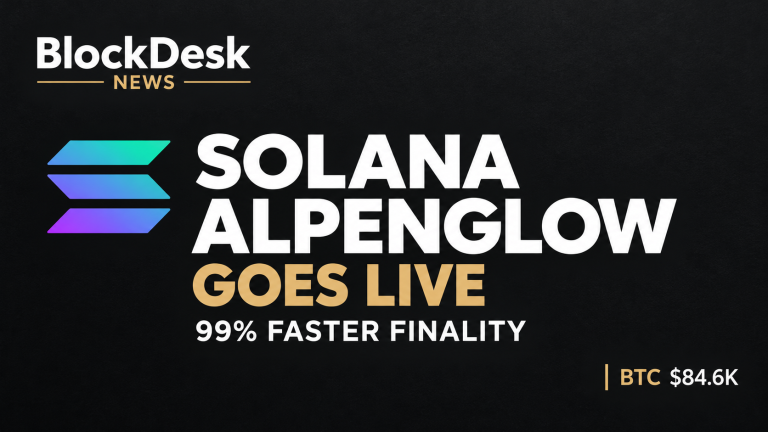
The week’s single most consequential development in crypto landed on Wednesday when Solana’s Alpenglow consensus upgrade went live, slashing transaction finality times by 99% compared to the network’s prior architecture. The upgrade repositions Solana as the undisputed performance leader among Layer-1 blockchains — a title that carries real economic weight as decentralised applications, high-frequency trading protocols, and institutional settlement pipelines continue migrating on-chain.
Bitcoin, meanwhile, tagged $84,600 during the week’s trading sessions, reinforcing the broader thesis that the market’s macro tailwinds remain intact. The BTC print is notable not just for the number itself but for what it signals about risk appetite across the digital asset complex: altcoins with genuine technical upgrades are outperforming, while speculative micro-caps are being left behind. The divergence is becoming structural.
Solana’s Alpenglow upgrade delivers 99% faster finality — the most significant Layer-1 performance leap of the current cycle. For protocols demanding near-instant settlement, the competitive calculus across the entire blockchain landscape just shifted.
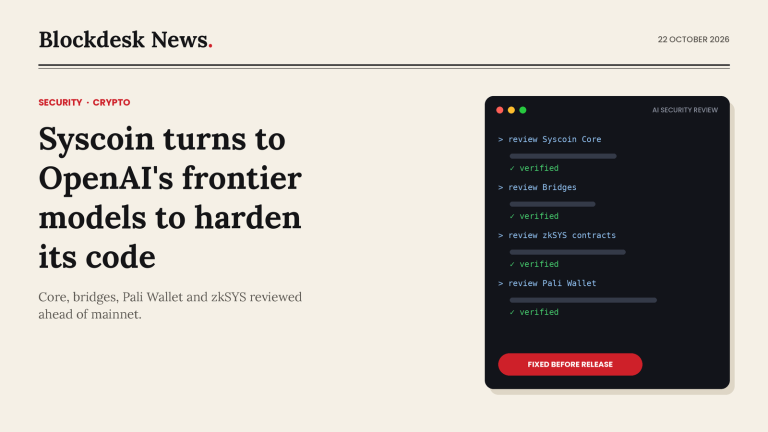
Also in crypto infrastructure, Syscoin — one of the longest-running blockchains merge-mined with Bitcoin — secured approval for OpenAI’s Trusted Access for Cyber programme, a deliberately difficult framework that grants verified security teams fewer refusals from frontier AI models when conducting legitimate defensive work. The team used the access to harden code across Syscoin Core, the Syscoin–Ethereum bridge, the zkSYS bridge, and smart account, gas tank, and token contracts ahead of the zkSYS zero-knowledge layer launch. According to the Syscoin Foundation, the review confirmed critical issues that could have permitted unauthorised movement of funds — all resolved before affected components shipped. The Pali Wallet review alone has accumulated nearly 1,000 AI-assisted pull requests since the wallet was rebuilt. Syscoin’s network currently operates with more than 2,000 enabled Sentry Nodes providing finality on top of its merge-mined proof-of-work base.
AI-assisted code review is only as good as the access level granted and the human oversight applied. While Syscoin’s frontier-model audit caught critical vulnerabilities before release, most blockchain projects lack the resources or approved access to replicate this process — leaving a widening security gap across the broader ecosystem.
AI & Technology
The AI infrastructure war entered a new phase this week as three separate data points confirmed that capital is flooding into compute and tooling at a pace that makes prior cycle valuations look conservative. Tenstorrent, the chip design company challenging Nvidia’s dominance in AI accelerator hardware, hit a $6.2 billion valuation — a number that reflects both the scale of institutional conviction and the market’s willingness to pay a premium for anything that credibly threatens the incumbent’s stranglehold on GPU supply chains.
Nvidia itself moved to expand its strategic footprint by unleashing an open agents framework, a developer-facing toolkit designed to make it easier to build autonomous AI systems on top of its hardware ecosystem. The move is textbook platform lock-in strategy: lower the barrier to building on your stack so that the installed base compounds faster than any competitor can attack it.
The week’s most striking statistic came from Town, an AI startup that reached unicorn status — a valuation above $1 billion — in just four months of operation. The speed of that milestone is without precedent in recent venture history and underscores the degree to which investors are front-running AI adoption curves rather than waiting for revenue proof points. Whether that urgency is justified or represents the leading edge of a valuation bubble is the central question the market will spend the next 12 months answering.
- Oct 19, 2026Tenstorrent confirmed at $6.2B valuation as institutional capital accelerates bets on Nvidia alternatives in the AI chip space.
- Oct 21, 2026Nvidia releases open agents framework, deepening developer lock-in across its AI hardware ecosystem.
- Oct 21, 2026Town reaches unicorn status in four months — among the fastest trajectories in venture-backed AI history.
- Oct 24, 2026Syscoin Foundation confirms OpenAI Trusted Access for Cyber approval; frontier AI audit catches critical pre-launch vulnerabilities in zkSYS stack.
Global Markets
U.S. equities spent the week navigating a treacherous macro crosscurrent: an earnings season that is simultaneously delivering headline beats and quietly revealing the cost pressures that stretched valuations have so far been able to ignore. The S&P 500’s forward price-to-earnings multiple remains elevated by historical standards, and this reporting season is functioning as the first systematic stress test of whether the AI-driven productivity narrative can justify those multiples in real cash flow terms.
The picture is mixed. Large-cap technology names with direct AI revenue exposure are holding ground, while companies that benefited from post-pandemic demand normalization are showing margin compression as input costs stabilize at levels above pre-2022 baselines. The bond market continued to exert gravitational pressure on equity valuations, with the yield curve sending signals that the terminal rate debate is far from resolved despite the Federal Reserve’s posture.
Globally, the macro backdrop remains asymmetric: capital continues to flow into dollar-denominated assets as geopolitical uncertainty sustains demand for perceived safe havens, but that same dollar strength is creating stress in emerging market debt structures that could become a systemic variable before year-end. Traders watching the cross-asset correlation between Treasury yields, the dollar index, and risk assets like Bitcoin will note that the relationships that held through most of 2025 are beginning to show strain — a pattern that historically precedes volatility regime changes.
Earnings season is exposing a gap between headline EPS beats and underlying margin quality across mid-cap equities. If the next two weeks of reporting fail to validate AI productivity gains at the revenue line, the multiple compression risk for the broader index accelerates sharply into Q4.
Trading Cards
This week’s coverage touched on a dimension of brand economics that rarely gets serious analytical treatment: the measurable financial consequences of celebrity exposure cycles. Analysis of the Strictly Come Dancing Week Four exit illuminated how participation in high-viewership entertainment formats functions as a quantifiable brand value event — with post-show commercial opportunity, social following trajectory, and endorsement pricing all shifting materially based on performance arc and exit timing rather than pre-show profile alone.
The core insight applies directly to asset markets: brand value is not static, it is a function of narrative momentum. A competitor who exits early with a compelling story can generate more durable commercial value than a finalist who peaks too early and loses cultural salience before the series concludes. The parallel to trading is direct — entry and exit timing relative to momentum cycles determines realized value regardless of underlying quality. It is a framework that experienced traders apply instinctively, and it is increasingly being formalized in brand equity models used by entertainment licensing desks and sports representation firms to price talent contracts.
British television’s economics are also a useful lens on the broader media consolidation story playing out globally: high-engagement, appointment-viewing formats retain pricing power in an increasingly fragmented attention economy, and the underlying IP and talent relationships that power those formats are being valued accordingly by acquirers surveying the content landscape.
Investor Takeaways
Both crypto and AI are rewarding genuine infrastructure upgrades with outsized capital inflows. Solana’s Alpenglow and Tenstorrent’s $6.2B raise share the same investor thesis: performance differentiation at the protocol or silicon level commands a durable premium.
Syscoin’s frontier-model audit identified critical fund-movement vulnerabilities before launch. Most projects cannot replicate this. Security-focused AI tooling sits at the intersection of two high-growth sectors and remains structurally undervalued.
The equity market’s next four weeks of reporting will either validate or challenge AI productivity multiples at the revenue line. The outcome directly shapes cross-asset risk appetite — including crypto’s ability to hold above $80K into year-end.
From celebrity brand cycles to token upgrades, this week’s coverage reinforces a consistent principle: entry and exit timing relative to narrative momentum determines realized value. Quality alone does not generate alpha — positioning within the cycle does.
Infrastructure Wins, Valuation Stress, and the AI Security Imperative
The week’s dominant theme is capital selecting for verifiable technical differentiation. Solana’s Alpenglow upgrade is not a roadmap promise — it is a live network change that redraws the Layer-1 competitive map. Tenstorrent’s $6.2 billion and Town’s four-month unicorn trajectory confirm that AI infrastructure capital allocation has moved from exploratory to conviction-level. These are not speculative bets on future utility; they are structural positions on who controls the compute and consensus layers of the next economic cycle.
The risk vector that deserves more attention than it is getting is code security at the intersection of AI and blockchain. Syscoin’s experience — frontier-model access identifying critical vulnerabilities that standard review would likely have missed — is not an edge case. It is a preview of the minimum viable security standard for any project holding user funds in a world where smart contract complexity is compounding faster than human review capacity. Projects that do not close that gap are carrying tail risk that is not priced into their valuations.
In the week ahead, watch U.S. earnings for any major AI-adjacent name that misses on revenue rather than just margins — that is the signal that would force a genuine multiple reassessment. In crypto, monitor whether Solana’s Alpenglow performance metrics translate into measurable DEX volume and institutional settlement uptake. And track whether Bitcoin can consolidate above $84K or whether profit-taking at resistance creates the first meaningful pullback since the latest leg higher began.
This article is for informational purposes only and does not constitute financial advice. Always conduct your own research before making investment decisions.