Meta Launches Muse Wonder and Wonder Full — Its First Frontier Models Built to Dethrone OpenAI and Anthropic
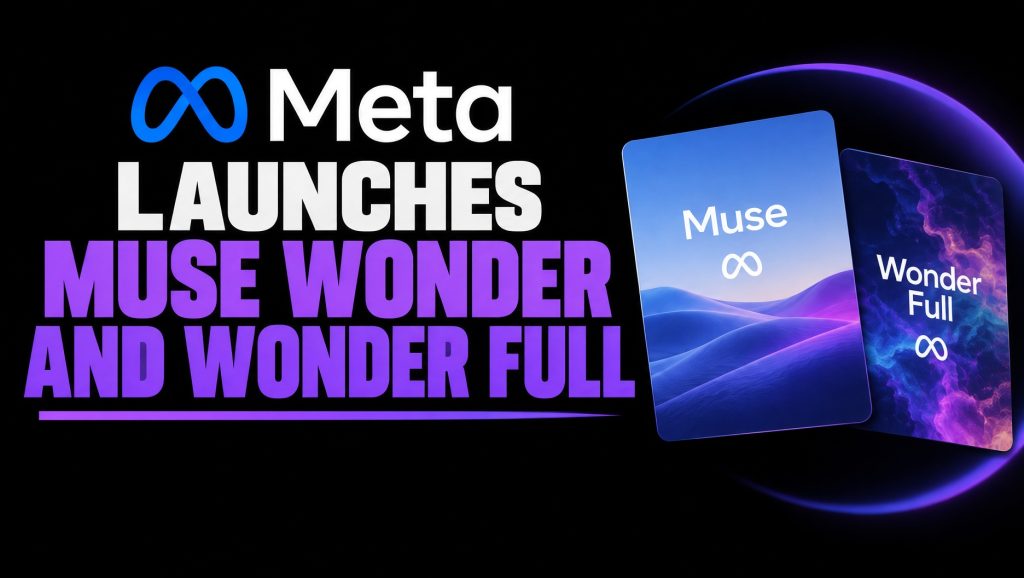
Meta’s Superintelligence Labs has fired its most consequential salvo yet in the AI model wars. On October 12, 2026, the company officially launched Muse Wonder and Muse Wonder Full — its first self-described frontier models — claiming direct competitive parity with OpenAI’s GPT-6 Astra and Anthropic’s Claude Opus 5.5 and Claude Fable 5.1. This is no longer a company playing catch-up. Meta is planting a flag at the frontier.
The Development and Its Significance
Meta’s release of Muse Wonder and Muse Wonder Full marks a definitive inflection point in the company’s AI trajectory. These are not iterative upgrades or repositioned open-source releases — they are frontier-class models, larger and more capable than anything Meta’s Superintelligence Labs has shipped before. Where the earlier Muse Spark was engineered for lightweight, low-latency inference, the Wonder series is built for depth: higher benchmark scores, superior performance on complex coding tasks, and the raw capability to operate as the backbone of a full-scale AI agent platform.
The strategic intent is explicit. Meta plans to deploy Muse Wonder as the core intelligence powering its Muse AI agent, initially rolling it out to subscribers before expanding to the broader Muse user base. The company has also signaled plans to develop specialized derivative models tailored to specific tasks — all distributed through Muse. This positions the Wonder series not merely as a model launch, but as the foundation of an entire consumer and enterprise AI ecosystem.
The timing is deliberate. The AI market’s competitive center of gravity has decisively shifted toward capable, multi-modal, agent-ready frontier models. OpenAI and Anthropic have held that high ground for the better part of two years. Meta’s Wonder launch is a direct bid to reclaim relevance at the top tier — and based on internal benchmark data the company is citing, it believes it has earned that position.
Meta asserts that Muse Wonder and Muse Wonder Full match or exceed the performance of GPT-6 Astra, Claude Opus 5.5, and Claude Fable 5.1 across multiple industry benchmarks — results drawn from internal testing conducted by Meta’s Superintelligence Labs division.
Technical Context: From Spark to Wonder
Meta’s model architecture strategy is becoming clear through its product sequencing. Muse Spark, the first model out of the Superintelligence Labs, was purpose-built for speed — optimized for low-latency deployments where response time is the primary constraint. It served as a proof-of-concept for the division’s ability to ship production-grade models, but it was never positioned as a frontier contender.
The Wonder series is a different animal entirely. These are larger models, trained on a significantly greater compute budget, with benchmark results on complex reasoning, coding, and instruction-following tasks that Meta claims rival the industry’s best. The distinction matters: scaling to frontier-class capability requires not just more parameters, but advances in training methodology, data curation, and evaluation rigor. Meta’s ability to credibly make this claim — and back it with internal benchmark data against named competitors — signals that the Superintelligence Labs has operationalized a serious research and engineering pipeline.
Muse Wonder is accessible through the Meta Model API immediately, making it available to developers building third-party applications. Muse Wonder Full, the more capable variant, is available to Muse Code subscribers starting today. The tiered access model mirrors strategies deployed by OpenAI and Anthropic — monetizing frontier capability while maintaining a developer-facing API layer to build ecosystem lock-in.
Key Players and Products
Meta’s flagship frontier model, available via the Meta Model API. Larger and more capable than Muse Spark, with higher benchmark scores on coding and complex reasoning tasks. Targeted at developers and enterprise API consumers.
The premium tier of Meta’s new frontier lineup, available exclusively to Muse Code subscribers. Positioned as a direct rival to GPT-6 Astra and Claude Opus 5.5. Will eventually power the Muse AI agent for all users.
Meta’s consumer-facing AI agent platform, set to be powered by Wonder-class models. Initially deploying to subscribers, with broader rollout and specialized derivative models planned — timeline unconfirmed.
Meta’s standalone image generation model, part of the broader Muse product family. Demonstrates the company’s ambition to build a full-stack AI product suite under a unified brand architecture.
Meta’s AI Push: A Timeline
- Early 2026Meta restructures its AI efforts under the newly formed Superintelligence Labs division, consolidating research and product teams with a mandate to compete at the frontier.
- Mid 2026Muse Spark launches — the first model from Superintelligence Labs. Lightweight, low-latency design signals a phased model release strategy. Muse Image also ships as part of the broader Muse product family.
- Mid 2026Meta launches the Muse AI agent to the public, establishing a consumer-facing deployment surface for its model lineup and setting the stage for future Wonder-powered upgrades.
- October 12, 2026Muse Wonder and Muse Wonder Full go live. Meta claims frontier parity with OpenAI GPT-6 Astra, Claude Opus 5.5, and Claude Fable 5.1. API access opens for developers; Muse Code subscribers get Wonder Full.
Investment Implications
Meta has poured billions into AI talent acquisition and infrastructure over the past two years, and the Wonder launch is the first moment that spending translates into a credible frontier model claim. For investors, this matters on multiple dimensions. First, it validates the Superintelligence Labs as a functional research division capable of producing competitive outputs — not just a rebranded R&D team. Second, it creates a monetization vector through Muse Code subscriptions, layering recurring revenue onto Meta’s existing advertising-dominated business model.
The Meta Model API access for Wonder also opens an enterprise and developer revenue stream that mirrors the API businesses OpenAI and Anthropic have built into multi-billion-dollar annual recurring revenue engines. If Meta can capture even a fraction of that market — particularly by undercutting on price or bundling with existing Meta business products — the financial upside is material. The broader Muse ecosystem, encompassing Wonder, Wonder Full, Image, and the Muse agent, positions Meta to compete across consumer, developer, and enterprise segments simultaneously.
The competitive threat to incumbent AI labs is real. OpenAI and Anthropic have enjoyed pricing power at the frontier precisely because supply of genuinely capable models has been constrained. Meta’s entry — especially with the open API strategy — has the potential to compress margins across the industry.
Risks and Limitations
Meta’s benchmark claims rest entirely on internal testing — no independent third-party evaluation has been published. The comparison to GPT-6 Astra and Claude Opus 5.5 cannot be verified externally at this stage. Additionally, Meta has provided no timeline or specifics for when Wonder will power the Muse agent at scale for all users, creating execution risk. Google’s Gemini 4 Argon, whose full capabilities remain opaque, represents an unquantified competitive variable. Regulatory scrutiny of Meta’s AI ambitions — particularly around data practices and market concentration — also looms as a persistent overhang.
Beyond benchmark credibility, Meta faces an adoption friction challenge. Enterprise and developer buyers have existing integrations with OpenAI and Anthropic’s APIs, and switching costs are non-trivial. Consumer trust in Meta’s AI products has historically lagged behind the company’s technical ambitions. Wonder Full’s Muse Code subscriber gate also limits near-term reach — the broader Muse rollout is promised but undated. Meta must execute on distribution as cleanly as it has on the model release itself.
Meta Has Arrived at the Frontier — Now Comes the Hard Part
The launch of Muse Wonder and Muse Wonder Full is the most significant AI move Meta has made since reorganizing under the Superintelligence Labs banner. The company has shipped what it credibly claims are frontier-class models, opened API access to developers, and laid the technical groundwork for a Wonder-powered Muse agent ecosystem. The strategic architecture is sound, the competitive intent is unambiguous, and the billions invested in talent and infrastructure are finally producing visible output.
Watch for three things: independent benchmark verification that either confirms or challenges Meta’s parity claims against GPT-6 Astra and Claude Opus 5.5; the speed and scale at which Meta rolls Wonder out to all Muse users beyond the subscriber tier; and how aggressively the company prices its API relative to incumbent providers. If Meta competes on cost while delivering frontier performance, the pricing dynamics across the entire AI model market shift materially. This story is not over — it is just beginning.
This article is for informational purposes only and does not constitute financial advice. Always conduct your own research before making investment decisions.