Trading Cards Are the New Alternative Asset Class — And the Smart Money Is Already In
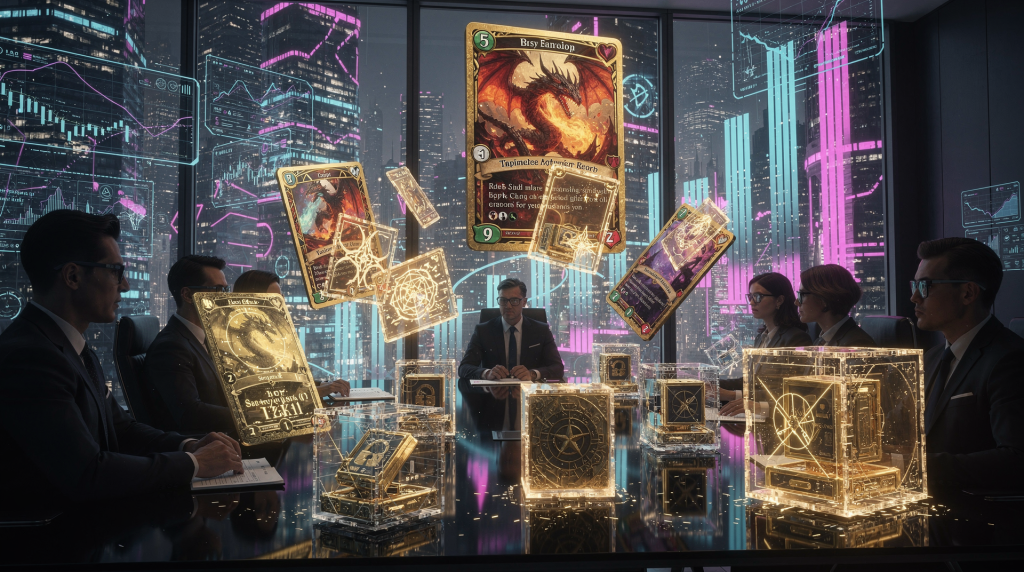
Trading card games have crossed a threshold that Wall Street can no longer ignore. What began as hobby-store nostalgia has matured into a multi-billion-dollar alternative asset class — one where a single PSA 10 Charizard commands more per square inch than Manhattan office space, where sealed booster boxes outperform the S&P 500 over five-year horizons, and where the next wave of breakout sets from One Piece, Yu-Gi-Oh!, and Magic: The Gathering is already being priced by institutional scouts before the shrink wrap comes off.
The Story: Cardboard as a Store of Value
The trading card investment market did not emerge overnight. It was built over three decades of scarcity engineering, nostalgia cycles, and the professionalization of grading services like PSA and BGS. What changed in the 2020s was the convergence of two forces: pandemic-era liquidity flooding into collectibles, and the arrival of a new generation of high-earning millennials who grew up with these games and now have the disposable income to chase them seriously.
Collectors care because the math works — when it works. A factory-sealed first-edition Pokémon Base Set booster box, purchased for roughly $100 at retail in 1999, has traded hands in the $400,000–$500,000 range at major auction houses. That is a return profile that competes with venture capital, without the cap table complexity. The key insight driving institutional curiosity is that the highest-grade, lowest-population cards behave less like consumer goods and more like fine art: illiquid, emotionally charged, and stubbornly resistant to depreciation once demand is established.
Yu-Gi-Oh! has carved its own lane in this ecosystem. The game’s early sets — Legend of Blue Eyes White Dragon, Metal Raiders, and the notorious Tournament Pack promos — have seen PSA 10 population counts remain in the single or low double digits for key holos, creating a scarcity profile that accelerates price appreciation whenever a content creator or competitive event reignites interest in the IP. The game’s ongoing competitive meta, managed through quarterly F&L List updates, also generates short-term price spikes for tournament staples — a dynamic that separates Yu-Gi-Oh! from purely nostalgic plays.
The One Piece Card Game, launched internationally in 2022, represents the most aggressive growth story in the current TCG investment landscape. Bandai’s decision to enforce strict regional print allocations created artificial scarcity at release, driving sealed booster box prices for early sets like Romance Dawn and Paramount War to multiples of their suggested retail price within weeks. Special Illustration Rare variants — the game’s chase-tier cards — have routinely cleared $500 to $2,000 at secondary market within months of release, attracting a cohort of investors who treat new set drops the way sneaker flippers treat limited Jordan colorways.
Magic: The Gathering remains the anchor of the TCG investment universe, and its financial dynamics are the most complex of any game in the space. The elimination of dedicated reprint sets like Modern Masters has created a structural supply constraint that is driving legacy staples to prices that have no realistic ceiling. Mox Opal — banned from Modern but still coveted — has climbed from a pre-ban floor of roughly $90 to a current market floor of $250, with no credible reprint mechanism visible on the horizon. The card’s continued appreciation post-ban underscores a critical lesson for TCG investors: playability matters less than scarcity and cultural cachet once a card reaches icon status.
Mox Amber (Retro frame) climbed from $27 in 2024 to $87 by early 2026 — a 222% gain in under two years — despite receiving a reprint on a bonus artifact sheet. The lesson: scarcity-tier reprints do not meaningfully suppress demand for prestige formats. Collectors pay for the original print run’s identity, not just the card’s function.
Market Context: Where New Sets Meet Old Money
The TCG investment market in 2026 is defined by the tension between publisher print run decisions and secondary market demand. Publishers have learned that artificial scarcity drives short-term hype but breeds long-term resentment; unlimited print runs suppress investor interest but maintain player accessibility. Most major publishers are currently threading this needle with tiered rarity structures — standard print runs for playable commons and uncommons, with dramatically restricted print runs for special illustration variants, foil treatments, and serialized cards.
Magic’s Secrets of Strixhaven, currently in active spoiler season, exemplifies this strategy. The set reintroduces a Mystical Archives bonus sheet — a curated selection of historically significant spells rendered in alternate art treatments — alongside a new cycle of Commander-fetchable dual lands being described by market observers as potentially staple-level. Ancestral Recall’s reappearance on a “prepare” mechanic variant generated immediate pre-order movement, with collectors and speculators alike recognizing that any card carrying Recall’s visual and mechanical lineage commands premium attention regardless of functional power level.
The Union Arena and Cyberpunk Red card games occupy a different corner of the investment thesis: emerging games with small but intensely committed player bases, where early-set sealed product represents a high-risk, high-reward bet on IP longevity. Investors in these games are essentially making a venture bet — if the game achieves critical mass, early sealed boxes become exponentially more valuable. If the game fades, the product is essentially worthless beyond a small collector community.
Key Cards and Sets to Watch
The benchmark of the entire TCG investment market. PSA 10 Charizard #4 peaked at $420,000 in 2022. Population remains under 120 copies graded at gem mint, sustaining price floors despite market corrections. First Edition stamp adds a 4–8x premium over Unlimited printings.
At $250 per copy with four required for a competitive Affinity build, Mox Opal represents a $1,000 barrier-to-entry single card slot. No reprint set mechanism currently exists. Bonus sheet reprints are projected to have minimal price impact based on Mox Amber precedent.
Early Tournament Pack prints of cards like Dark Magician Girl and Jinzo carry PSA 10 populations in the single digits. These cards sit at the intersection of competitive nostalgia and extreme scarcity — a combination that has historically produced sustained five-figure valuations.
Special Illustration Rares from the inaugural One Piece set have held $500–$2,000+ price points since release. Sealed booster boxes of Romance Dawn have traded at 300–400% of MSRP on secondary markets, driven by strict regional print allocations from Bandai.
The Investment Angle: Grading, Scarcity, and Liquidity Windows
Professional grading is the single most important variable in TCG investment. A raw near-mint copy of a sought-after card and its PSA 10 equivalent can differ in price by 500% or more. PSA population reports — publicly available databases showing how many copies of a given card have been graded at each tier — function as the TCG equivalent of a circulating supply metric. Investors monitor population growth carefully: a card with a PSA 10 population of 8 is a fundamentally different asset than one with a population of 800.
The liquidity dynamics of TCG investing differ sharply from equities. High-value cards transact through auction houses, private broker networks, and established platforms — processes that can take weeks to months. Sealed product is more liquid than singles at the lower end of the price spectrum, but the highest-value sealed boxes face the same thin-market problem as trophy cards. Investors who need quick exits often face meaningful discounts to last sale price, particularly in softening market conditions.
The emerging “sealed vault” model — where investors purchase sealed product and store it in climate-controlled, third-party custodial facilities — has added a layer of institutional credibility to the asset class. Several custodial platforms now offer fractional ownership of high-value sealed boxes and graded cards, lowering the entry barrier and introducing a degree of price discovery that the private market historically lacked.
When PSA population counts for a key card remain below 50 copies at gem mint across all printings, price floors become structurally defensible. Investors tracking Yu-Gi-Oh!’s earliest Tournament Pack promos note that some key holos have seen zero population growth in 18+ months — meaning no new gem-mint copies are entering the market regardless of demand. This supply lock is the closest analog in physical collectibles to a Bitcoin hard cap.
Price History: The Appreciation Timeline
-
1999–2003First-wave TCG sets released at retail. Pokémon Base Set, Yu-Gi-Oh! Legend of Blue Eyes, and early Magic expansions printed in quantities that seemed enormous at the time but proved finite relative to future demand. Sealed product retailed for $3–$5 per booster pack.
-
2008–2016Gradual price appreciation for first-edition holos and Legacy Magic staples. PSA grading volume for TCGs increases as collectors recognize the value premium of certified gem mint copies. Mox Opal establishes itself as a Modern staple; early copies trade under $30.
-
2020–2022Pandemic liquidity event triggers explosive TCG price appreciation across all major games. PSA 10 Charizard peaks near $420,000. Sealed vintage Pokémon boxes reach six figures. YouTube and streaming exposure drives mainstream awareness of the investment thesis. One Piece TCG launches internationally.
-
2023–2024Market correction softens mid-tier card prices by 30–50%, but top-tier PSA 10 population-1 cards hold value. Mox Amber climbs from $27 to $87. One Piece Romance Dawn sealed boxes reach 3–4x MSRP. Institutional sealed vault platforms launch fractional ownership products.
-
2025–2026Magic’s Secrets of Strixhaven enters spoiler season with Mystical Archives and Ancestral Recall variants driving speculator attention. Mox Opal breaches $250 with no reprint mechanism in sight. Yu-Gi-Oh! GENESYS-era competitive meta generates new demand for specific staple cards. TCG investing enters mainstream financial media coverage.
The TCG investment market carries risks that no amount of PSA population data can fully hedge. Publisher reprint decisions remain the single greatest threat to individual card valuations — and publishers are under constant player pressure to improve accessibility. Condition sensitivity is brutal: a single surface scratch separating a PSA 9 from a PSA 10 can represent a $10,000+ valuation gap on trophy cards. The market is also entirely unregulated, with no standardized pricing infrastructure, making manipulation and wash trading through private sales difficult to detect. Liquidity crises in the broader collectibles market — as seen in the 2022–2023 correction — can cascade into TCG prices faster than most investors expect, particularly for mid-tier cards that lack the cultural cachet of true trophy-tier assets. Emerging games like One Piece, Union Arena, and Cyberpunk Red carry additional IP-longevity risk: if publisher support wanes, early-set sealed product can move from speculative premium to near-zero with limited warning.
Cardboard Alpha: The Case for TCGs as a Legitimate Alternative Asset Allocation
Trading card games have earned their place in the alternative asset conversation — not as a speculative curiosity, but
Yu-Gi-Oh! Asian English October 2026 Banlist Drops PSY-Frame Lord Omega to Zero, Hits Five More Cards
Yu-Gi-Oh! OCG Tournament Pack 2026 Vol. 3 Confirms Four Reprints Targeting Immortal Phoenix Decks

Pokémon TCG’s New ex★ Series Revealed at 2026 World Championships: Mega Lucario Z Leads Massive Mega Evolution Comeback
Blockchain news
Markets, on-chain and the desk's reporting in your inbox each morning.