Shielded Zcash, Explained: How Private Transactions Work — and What Ironwood Changes
This is the pilot article for “Zcash Explained,” a proposed educational series from BlockDesk News. Not investment advice.
Most crypto is public by default.
Every Bitcoin and Ethereum transaction sits on an open ledger. Anyone can look up an address and see the balance, the history, the counterparties, the timestamps. Forever.
Zcash was built to offer the opposite: a way to transact on a blockchain without putting your entire financial life on display.
And right now, Zcash is rolling out one of the most consequential upgrades in its recent history — a fix aimed squarely at the one hard question a private currency has to answer. Here’s the plain-language guide to how the technology works, and what’s about to change.
The two kinds of Zcash addresses
Zcash gives you a choice.
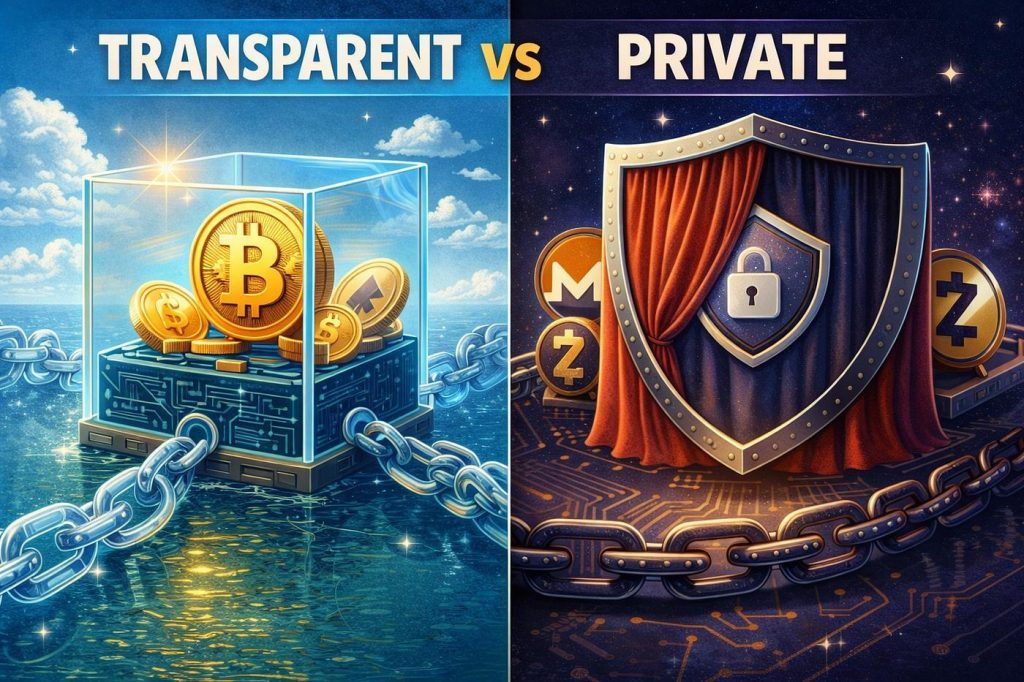
Transparent addresses work like Bitcoin. Public sender, public receiver, public amount. Anyone can trace them.
Shielded addresses are the private ones. When you send between two shielded addresses, the network confirms the transaction is valid — while the sender, receiver, and amount stay encrypted.
That’s the core idea people mean when they say “shielded.” Not hidden from the blockchain. Verified by the blockchain, without the details being exposed.
How that’s even possible: zero-knowledge proofs
The technology underneath is called a zero-knowledge proof.
Plain version: it lets you prove something is true without revealing the thing itself.
Applied to money, it lets Zcash confirm you actually had the funds, and didn’t spend them twice — without showing your balance or who you paid.
The network checks the math. It just doesn’t see the details.
This is advanced cryptography, and Zcash has been refining it longer than anyone in the space. Zcash’s 2016 launch was the first production deployment of general-purpose zero-knowledge proofs anywhere — not just the first in crypto, but the first, period. The current version of its shielded system is called the Orchard pool — the most efficient private-transaction technology Zcash has shipped.
What Ironwood changes
Ironwood is Zcash’s next network upgrade, formally designated NU6.3. It’s scheduled to activate on July 28, 2026, and it’s the development the ecosystem has been focused on.
To understand why it matters, you need the backstory.
Because shielded transactions are private, users have historically had to trust that the total Zcash supply was accurate — you can’t simply add up private balances the way you can on a public chain. That trust assumption became a live problem in mid-2026, when a security researcher found a soundness flaw deep in the Orchard pool. In theory, the bug could have allowed someone to create counterfeit ZEC that ordinary checks wouldn’t catch.
Developers patched it quickly through an emergency network fork, and no evidence has been found that anyone ever exploited it. But here’s the catch, and it’s the whole reason Ironwood exists: because Orchard is private by design, nobody can cryptographically prove the negative. You can show it probably never happened. You can’t show it definitely didn’t.
Ironwood fixes that going forward. It opens a new shielded pool built on the patched Orchard circuit, and requires funds to migrate into it through Zcash’s existing “turnstile” mechanism — an accounting checkpoint that mathematically bounds how much ZEC can leave the old pool. Once migration is complete, anyone running a node can independently verify that the circulating supply is sound, without breaking the privacy of any individual transaction.
Keep the privacy. Restore the ability to verify.
The harder part isn’t the cryptography — it’s coordination. Exchanges, wallets, and mining pools all have to move to the new software together, which is why the activation date slipped by a week from its original target. (Ironwood also carries early groundwork — new note formats under ZIP 2005 — toward protecting shielded funds against future quantum computers. That’s a separate, longer road, tied to the larger NU7 upgrade still ahead.)
The signal most people missed
While the headlines focused on price, a quieter number told a bigger story.
The share of Zcash held in shielded addresses climbed from a small single-digit fraction in early 2024 to around 30% of circulating supply by 2026.
That matters because shielding is a deliberate act. Coins sitting on an exchange aren’t shielded. To shield, a holder has to actively move funds into a private address themselves.
So a rising shielded percentage isn’t hype. It’s people actually using the privacy features — the entire point of the network. And that number kept climbing straight through a turbulent year.
More momentum worth knowing
The regulatory picture cleared. In January 2026, the SEC closed a long-running investigation into the Zcash Foundation — open since a 2023 subpoena — with no enforcement action, lifting a legal cloud that had lingered for years. Grayscale has since filed to convert its Zcash trust into a spot ETF, which would be the first spot ETF for a privacy coin in the US.
The technology keeps advancing. A 2026 testnet upgrade roughly doubled the speed of shielded transactions, and the project has begun laying the groundwork for “quantum-recoverable” wallets — an early step toward protecting private transactions against future quantum computers.
A note on names: Zashi is now Zodl
If you’ve read about Zcash before, you’ve probably seen the Zashi wallet mentioned. It’s the same wallet — it just has a new name.
In January 2026, the core development team behind Zcash’s protocol and the Zashi wallet left the Electric Coin Company after a governance dispute, and formed an independent organization called the Zcash Open Development Lab (ZODL). In February, they renamed the wallet from Zashi to Zodl to match.
For users, nothing about the wallet itself changed. Same app, same team, same code, same recovery phrase — the update rolls out in place, with no need to reinstall or move funds. Only the name and branding are different. It’s worth knowing simply so you’re not confused when you see both names referenced across older and newer guides.
How to actually use shielded Zcash
If you hold ZEC on an exchange, it isn’t private. The exchange holds it in a transparent address.
Privacy activates when you withdraw to your own shielded wallet. There’s no single “official” Zcash wallet — it’s an open, permissionless system supported by many wallets, including Zodl, Vizor, Unstoppable Wallet, Zingo!, Ywallet/Zkool, Edge Wallet, and the Brave browser wallet, among others. ZecHub maintains a full list at zechub.wiki/wallets.
For a first-time user, Zodl (formerly Zashi) is one of the more beginner-friendly options — a self-custody, Zcash-only wallet that manages shielding for you through a Zcash “unified address.” You can get it from its App Store or Google Play listing, or via the project’s home at https://zodl.com. Whichever wallet you choose, verify you’re downloading the genuine app and never share your recovery phrase with anyone.
One thing worth knowing: when you move funds from a transparent address into a shielded one, that shielding transaction itself is visible on-chain. Only what happens afterward, inside the shielded pool, is private.
Zcash gives you privacy going forward — not backward.
The bottom line
Zcash has always had some of the strongest privacy technology in crypto. Its challenge was never the cryptography — it was usability, trust, and access.
Ironwood tackles the trust piece directly, by making supply verifiable again without sacrificing privacy. Clearer regulation is opening the access piece. And adoption of the privacy features is climbing on its own.
For a technology built on the simple idea that your financial life is yours, that’s a meaningful moment.