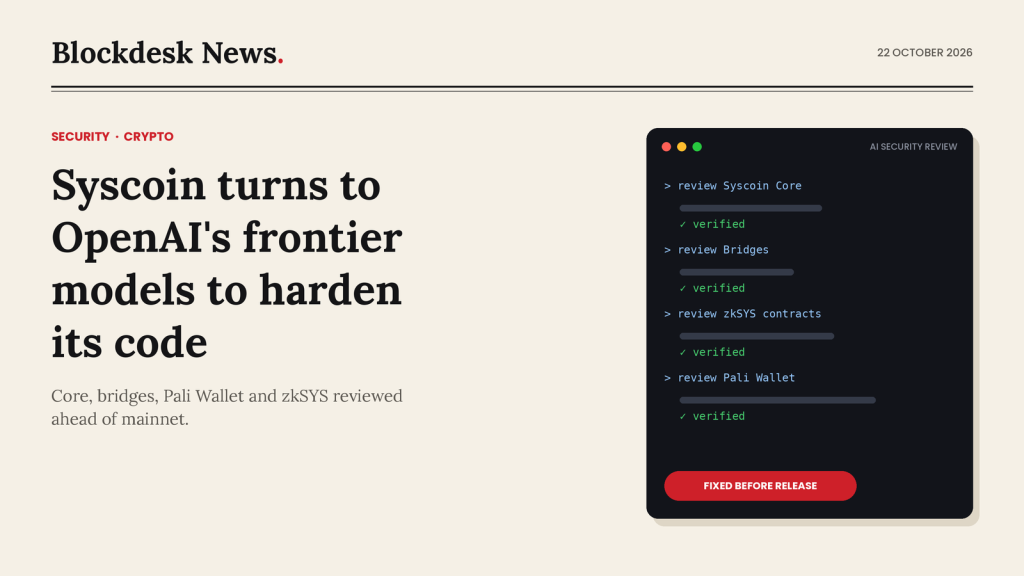
Syscoin Uses OpenAI’s Frontier Models to Harden Its Code Ahead of zkSYS Launch
BlockDesk News · 22 October 2026
Syscoin, one of the longest-running blockchains merge-mined with Bitcoin, has been approved for OpenAI’s Trusted Access for Syscoin, one of the longest-running blockchains merge-mined with Bitcoin, has been approved for OpenAI’s Trusted Access for Cyber programme [Daybreak]. Its core developers are using OpenAI’s frontier models to review and harden the project’s most sensitive code ahead of the launch of zkSYS, its new zero-knowledge layer.
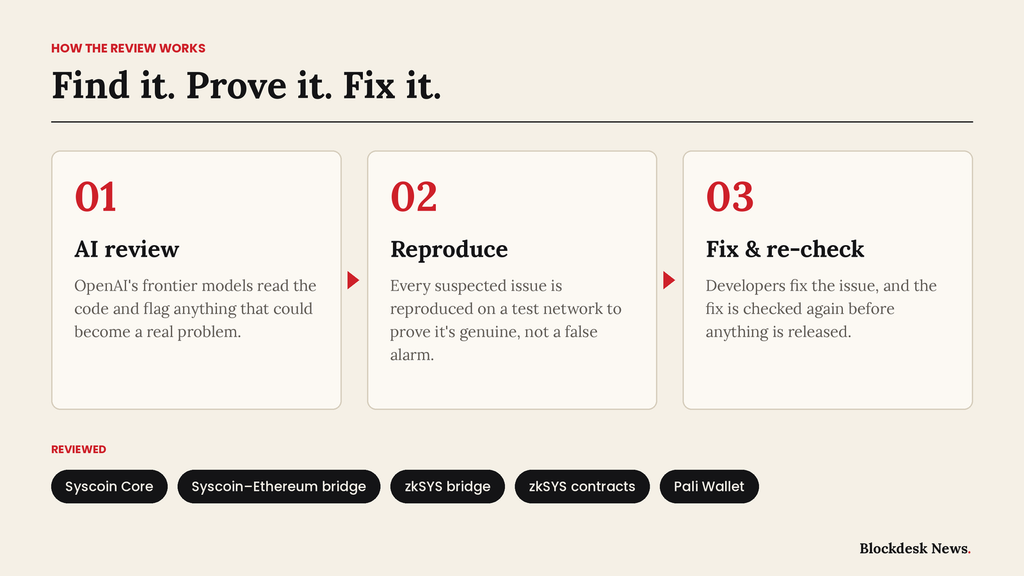
The team says the work covers Syscoin Core, the Syscoin–Ethereum bridge, the zkSYS bridge, zkSYS’s smart account, gas tank and token contracts, and Pali Wallet. [Link: official Syscoin announcement]
What OpenAI’s programme does
OpenAI runs Trusted Access for Cyber as an identity- and trust-based framework. It gives verified security teams fewer refusals from its most capable models when they do legitimate defensive work: secure code review, vulnerability triage and patch validation. In April, OpenAI expanded the programme and named supporting organisations including Cloudflare, CrowdStrike, Cisco and several major banks.
Getting in is deliberately hard. OpenAI’s own documentation says individuals must verify their identity and register a physical FIDO2 hardware security key, and that requests are reviewed before access is turned on. In OpenAI’s words: “Approval is not automatic.”
For a blockchain team, that access matters because standard models block much of the work defenders actually need to do, such as reproducing a suspected bug to prove it’s real.
“You’re actually telling [the model] to reproduce and make sure the bug is real, so it has to reproduce it on a mock network,” the Syscoin Foundation told BlockDesk News. “The normal model can’t do that. It will say you’re not authorised.”
Found, confirmed, fixed
According to the Syscoin Foundation, the process confirmed critical issues that could have allowed funds to be moved without authorisation, and all of them were fixed before the affected components were released.
The foundation sees frontier AI as essential for anyone holding user funds. “All these systems are going to break unless you have a frontier model to be able to defend your code,” it said.
The review also covered Pali Wallet’s key and seed phrase generation. The foundation pointed to cases across the industry where wallets lost funds because their randomness was not truly random. Every change to Pali now goes through pull requests reviewed by several AI layers and a developer, close to a thousand since the wallet was rebuilt. “We’ve set the bar at Apple-level quality,” the foundation said.
Why it matters now
Syscoin has spent more than a decade building on Bitcoin’s security model: merge-mined proof of work, with more than 2,000 enabled Sentry Nodes adding finality, according to the network dashboard sysnode.info. The project has also leaned into hash-based, post-quantum cryptography.
zkSYS is the next step: a fast zero-knowledge layer that settles to Syscoin. Its token cannot be bought in a presale. It is earned by the people who secure the network. With the final testnet live, the team says it is in the last stages of quality assurance before mainnet, alongside a new documentation portal written for both human readers and AI agents.
“Agents will be reading this, not even humans,” the foundation said of the new docs.
The bigger picture
AI models are now good enough to speed up vulnerability discovery on both sides. Programmes like OpenAI’s are a bet that verified defenders should have the strongest tools first. Syscoin is now talking openly about using that access across its whole stack. Whether other chains follow may shape how the next generation of networks is secured.
Disclosure: BlockDesk News is owned by Edward Sirofsky, who works with the zkSYS team on growth and partnerships.
Sources: OpenAI, “Trusted Access for Cyber” (openai.com/index/trusted-access-for-cyber); OpenAI Help Center, “OpenAI Daybreak – Trusted Access for Cyber Overview”; SecurityBrief, “OpenAI launches Trusted Access for Cyber with major names”; sysnode.info; Syscoin Foundation, 20 October 2026.