AI Infrastructure War Heats Up: Tenstorrent Hits $6.2B, Nvidia Unleashes Open Agents, Town Becomes Unicorn in 4 Months
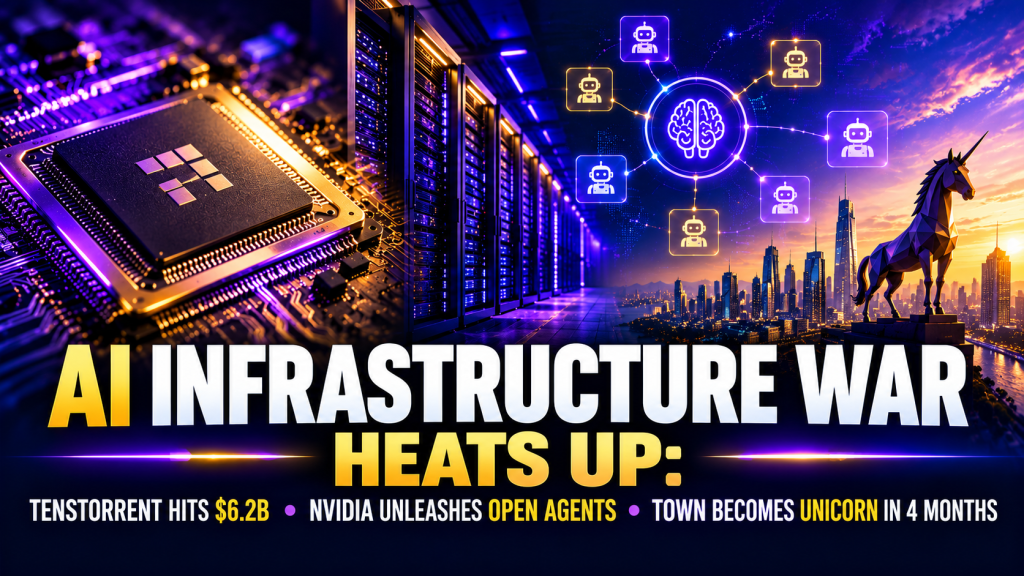
Three seismic moves landed on the same October day, drawing the battle lines of the AI infrastructure war with unprecedented clarity: Tenstorrent closed a $1.5 billion round at a $6.2 billion valuation to challenge Nvidia on open-weight silicon, Nvidia itself fired back by releasing open agentic models built for enterprise data centers and consumer PCs, and AI assistant startup Town vaulted to unicorn status just four months after launching — raising $108 million in a Series B that signals investors are nowhere near cooling on the space.
Tenstorrent Bets on Independence — and Open Silicon
Tenstorrent did not need to stay independent. Earlier in 2026, the company drew serious acquisition interest from multiple major players, a signal that the market understood exactly what it was building: a credible, open-weight alternative to Nvidia’s GPU ecosystem. The company chose a different path — raising $1.5 billion at a $6.2 billion valuation to scale its custom AI chip architecture on its own terms.
The strategic significance of that decision cannot be overstated. The AI chip market is structurally dominated by a single incumbent, and every enterprise, hyperscaler, and sovereign government building serious AI infrastructure knows the risks of that concentration. Tenstorrent’s pitch is architectural openness — chips designed with open-weight AI workloads in mind from the gate-level up, not retrofitted GPU clusters running models they were never designed to serve efficiently.
The $1.5 billion infusion gives Tenstorrent the runway to move from niche challenger to credible volume supplier. Chip development cycles are brutal — taping out a competitive accelerator demands hundreds of millions in R&D, fabrication commitments, and software ecosystem investment before a single production unit ships. At this capitalization level, Tenstorrent can run those cycles without blinking.
Tenstorrent’s decision to reject acquisition offers and raise independently at $6.2B reflects a calculated bet that the open-weight AI silicon market is large enough to support a standalone champion — one that can undercut Nvidia on cost while outperforming retrofitted GPU clusters on targeted inference workloads.
Nvidia’s Counter: Open Models for Enterprise and Edge
Nvidia’s response to the open-weight AI movement was not to resist it — it was to own it. On the same day Tenstorrent announced its raise, Nvidia released a new suite of open models specifically engineered to run autonomous agents both inside enterprise data centers and directly on consumer PCs. The move is a direct acknowledgment that enterprises increasingly demand AI they can deploy on their own infrastructure, with full data sovereignty and no API dependency.
The dual-deployment architecture — enterprise data center and on-device PC — is deliberate. Nvidia is not chasing a single segment; it is covering the entire deployment surface. Enterprise customers get open models they can fine-tune and run inside their own perimeter. PC users get private, local AI agents that function without a cloud connection. Both use cases route through Nvidia hardware, which is the point. The chip giant is not giving away software — it is using software to lock in silicon demand at every tier of the stack.
This is a textbook platform play. By releasing open models optimized for its own hardware, Nvidia shapes the performance benchmarks that competitors must beat, defines the software interfaces that developers build against, and ensures that when enterprises choose an open-weight deployment path, the path of least resistance still runs on green silicon.
Town: Unicorn in 120 Days
The application layer is moving at a different speed entirely. Town, an AI assistant startup, closed a $108 million Series B co-led by two prominent venture firms just four months after launching its product commercially. The round pushed the company’s valuation above the $1 billion unicorn threshold — one of the fastest climbs from launch to that milestone in the current AI cycle.
The velocity here is the story. Four months is not enough time to build a defensible moat, generate meaningful revenue scale, or establish enterprise switching costs. What Town has demonstrated is product-market resonance sharp enough to convince institutional capital that the AI assistant category will be enormous — and that Town’s approach to it is differentiated enough to win a material share. In a market where a dozen well-funded competitors are shipping similar products, that conviction carries weight.
- June 2026Town officially launches its AI assistant product commercially, entering a crowded but fast-growing market segment.
- Early 2026Tenstorrent draws acquisition interest from major industry players, signaling strategic value of its open-weight chip architecture.
- October 19, 2026Tenstorrent closes $1.5B raise at $6.2B valuation. Nvidia releases open agentic models for enterprise and PC. Town announces $108M Series B at unicorn valuation — all on the same trading day.
Key Players Reshaping the Stack
Open-weight AI chip challenger now capitalized at $6.2B. Rejected acquisition to scale independently, targeting enterprises seeking sovereign, cost-efficient AI silicon outside the Nvidia orbit.
Platform incumbent deploying open model releases as a software moat. New agentic models span enterprise data centers and consumer PCs — ensuring hardware demand regardless of deployment preference.
AI assistant startup that reached unicorn status in four months post-launch on the back of a $108M Series B co-led by Forerunner Ventures and Menlo Ventures. Fastest validation timeline of the current AI application wave.
The silent force driving all three stories. Demand for on-premise, data-sovereign, open-weight AI deployment is now capital-efficient enough to fund challengers and force incumbents to adapt simultaneously.
Investment Implications
Three developments in one day is not coincidence — it is convergence. The AI infrastructure market is entering a phase where capital allocation is bifurcating sharply: massive rounds at the silicon and platform layer (Tenstorrent’s $1.5 billion), and hyper-compressed valuation timelines at the application layer (Town’s four-month unicorn sprint). Both dynamics are sustainable only if enterprise AI spending continues to accelerate, which every available signal currently suggests it will.
For investors tracking infrastructure exposure, Tenstorrent’s independence is a direct opportunity vector. A chip company at $6.2 billion that is positioned as the primary open-weight alternative to a $3 trillion incumbent, and that has already demonstrated enough strategic value to attract acquirers, is a rare risk-reward profile. The question is not whether open-weight silicon has a market — Nvidia’s own open model releases confirm it does. The question is execution at scale.
At the application layer, Town’s trajectory compresses the due diligence timeline that VCs traditionally use to validate AI assistant plays. If a product can reach unicorn status in 120 days, the window for seed-stage entry in adjacent categories is narrowing fast. Capital is pricing in winner-take-most dynamics even before usage data matures.
Nvidia’s simultaneous push into enterprise on-premise and consumer on-device open models indicates the company internally models the addressable deployment surface as large enough to justify full-stack software investment — a de facto endorsement of a multi-hundred-billion-dollar open AI infrastructure market.
Risks and Limitations
Tenstorrent carries the classic challenger risk: even a $6.2 billion capitalized company faces an incumbent with $3 trillion in market cap, a dominant software ecosystem (CUDA), and the ability to price defensively. Chip development timelines routinely slip, and a single failed tape-out can consume years of runway. Town’s unicorn valuation, achieved before meaningful revenue maturation, bakes in extreme growth assumptions that any market slowdown or competitive commoditization of AI assistants could rapidly unwind. Nvidia’s open model releases, while strategically sound, also invite scrutiny over whether truly open weights can remain a competitive differentiator when the most resourced player in the world is distributing them freely.
The Open-Weight War Is Now Fully Funded on Both Sides
October 19, 2026 will be remembered as the day the AI infrastructure battle crystallized into two simultaneous theaters: silicon sovereignty versus platform dominance, and application-layer velocity versus defensible moat building. Tenstorrent’s $1.5 billion bet on independence is the most significant direct challenge to GPU hegemony since the current AI cycle began. Nvidia’s open model release is the incumbent’s acknowledgment that the challenger’s thesis is correct — and its preemptive move to own the open-weight narrative before competitors do.
Watch Tenstorrent’s first major enterprise customer announcements and production volume milestones over the next two quarters. Watch whether Town converts its unicorn valuation into measurable revenue retention. And watch how aggressively Nvidia prices its open models relative to competing open-weight releases — that spread will define the competitive floor for the entire sector in 2027.
This article is for informational purposes only and does not constitute financial advice. Always conduct your own research before making investment decisions.